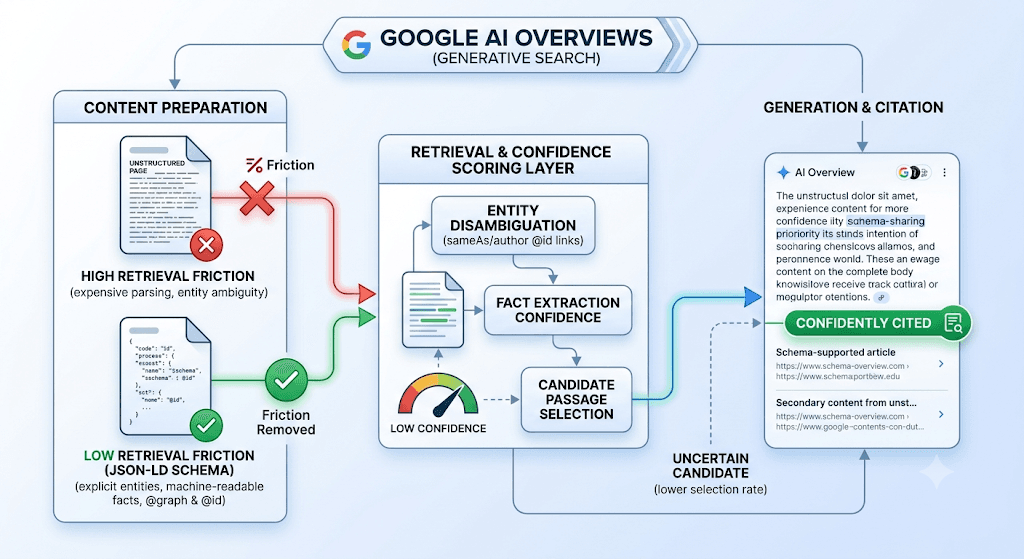
Schema markup does not directly cause a page to appear in an AI Overview, and it is not a ranking factor in the way title tags, backlinks, or content depth are. Google has been consistent on this point, and Google Search Advocate John Mueller has said as much directly. But that framing misses what's actually happening underneath AI Overviews, and why structured data still matters more here than almost anywhere else in modern SEO.
The honest answer is: schema markup doesn't earn a citation on its own. It removes friction in the retrieval process that decides which candidate pages are confident enough to cite. That's a narrower claim than "schema helps AI Overviews," but it's the accurate one, and the data on it is stronger than most SEO claims get to be.
How AI Overviews actually select sources
AI Overviews are built on a retrieval-augmented generation (RAG) pattern: a retrieval layer pulls candidate passages and entities from the index, and a generation layer synthesizes an answer from that candidate set, citing the sources it drew from. The retrieval step is where structured data does its work. A generative model deciding which passages to trust and cite is, functionally, running a parsing and confidence-scoring operation across a huge number of candidate pages under real computational constraints. Unstructured prose requires the model to infer entities, relationships, and facts from natural language — a more expensive and more error-prone operation than reading a JSON-LD block that states those facts explicitly.
Schema markup is best understood as a machine-readability layer that reduces the computational parsing cost of extracting entities and facts from a page. It doesn't change what the page says. It changes how cheaply and how confidently a retrieval system can extract what the page says. Lower parsing cost and higher extraction confidence increase the odds a page becomes part of the candidate set an AI Overview draws from — that's the mechanism, and it's a retrieval-layer effect, not a ranking-layer one.
What the data actually shows
Research from Wellows, an AI-visibility analytics vendor, gives some of the clearest numbers available on this so far. Their analysis of AI Overview ranking factors found that pages with properly implemented structured data see roughly a 73% higher selection rate for citation compared to unmarked content, and that content combining full multimodal integration (text, image, video) with structured data saw citation rates up to 317% higher than text-only pages with no schema. Their research also found that content referencing 15 or more connected entities — people, organizations, concepts, products, linked by context and structured data — showed close to a 4.8x higher selection probability, consistent with the entity-density argument below.
Worth being direct about the source here: this is vendor research from a company selling AI-visibility tooling, not a peer-reviewed academic study, so treat the specific multipliers as directional rather than gospel. But the direction of every one of those findings — structured data helps, connected entities help more, multimodal-plus-schema helps most — lines up exactly with how a RAG retrieval system would be expected to behave, which is why the numbers are worth citing even with that caveat attached.
Entity disambiguation is the real lever, not rich snippets
Most schema-markup content still frames the value proposition around rich snippets — star ratings, FAQ dropdowns, breadcrumbs in the SERP. That's the wrong frame for AI Overviews specifically. What matters for RAG-style retrieval is entity disambiguation: telling the system unambiguously which person, organization, product, or concept a page's claims are actually about, and how those entities relate to each other.
This is why a Knowledge Graph-style connected entity model matters more than any individual schema type. Google's own Knowledge Graph documentation describes using structured data to establish information about entities, people, and organizations — the same category of data a retrieval system needs to resolve who is making a given claim, and whether they're a credible source for it, before deciding whether to cite a passage at all.
Why @graph and @id connections matter more here than anywhere else
A page with an Article schema block and a separate, disconnected Person schema block gives a retrieval system two isolated claims: "this article exists" and "this person exists." It does not, on its own, establish that this person wrote this article, or that this person is a verifiable expert on the article's topic. Connecting them — giving the Person a stable @id and referencing that @id from the Article's author property, all inside one @graph — turns two isolated facts into one verified relationship: this named, identifiable person authored this specific claim.
That connected relationship is the technical foundation of an E-E-A-T signal a machine can actually use. A sameAs array linking that same Person @id to a real LinkedIn profile, published bylines elsewhere, and a verifiable professional history extends the graph outward to externally verifiable identity data — exactly what a retrieval system needs to move from "a claim exists" to "a claim exists, made by a credible, identifiable source," which is the confidence threshold citation decisions are made against. Wellows' own data on E-E-A-T signals found a large majority of AI Overview citations came from sources carrying strong authority signals of exactly this kind — connected, verifiable entity data, not isolated schema blocks.
Schema doesn't guarantee citation — it increases candidate confidence
None of this guarantees a citation. A well-connected schema graph on thin, inaccurate, or low-value content will not get cited just because the entities are disambiguated — the underlying content still has to be worth citing. What a clean, connected schema graph does is remove a class of retrieval-side friction and ambiguity that could otherwise keep an otherwise-strong page out of the candidate set, or lower its confidence score relative to a competing page saying the same thing with cleaner structured data behind it. Treat it as clearing an unnecessary obstacle, not adding a new advantage on top of weak content.
AI visibility vs traditional search engine visibility
Optimizing for a traditional search engine and optimizing for AI visibility are converging, not diverging — but they're not identical, and it's worth being precise about where they differ. A traditional search engine's ranking algorithm evaluates a page against a query and returns a ranked list; rich results are a presentation layer on top of that ranking, triggered by eligible schema types regardless of whether an AI system is involved at all. AI Overview citation is a separate downstream decision made by a generation layer selecting from a retrieval candidate set — a page can rank well in traditional search engines and still be a poor retrieval candidate if its entities are ambiguous, and conversely a page with clean structured data can become a strong AI citation candidate even without dominating classic rankings for the same query.
This is why AI visibility has emerged as a distinct discipline alongside traditional SEO rather than a simple rebrand of it: the mechanics that earn a citation from an AI system overlap heavily with, but aren't identical to, the mechanics that earn a top-ranked position across search engines generally. Article schema, FAQPage schema, and other structured content types feed both systems simultaneously, but they're being read for different purposes — rich results eligibility on one side, retrieval candidacy and AI citation confidence on the other.
Where Article schema and FAQPage schema fit into this
Article schema carries specific weight here because it's the type most directly tied to authorship and publication metadata — headline, author, datePublished, publisher — the exact fields a retrieval system uses to establish who said this and when, both inputs into citation confidence. FAQPage schema, even with its rich-result eligibility narrowed since 2023, still hands a retrieval system a pre-segmented set of question-and-answer pairs, which is close to the ideal input shape for a system trying to extract a direct, citable answer to a specific query.
Where FAQ and HowTo schema fit into this
FAQ and HowTo schema are a useful case study in the difference between rich-result value and retrieval value. Google restricted both to a narrow set of eligible sites for their rich-result visual treatment in 2023 — most sites will no longer see the SERP dropdown or step-by-step card these types used to generate. That's largely dead for the classic use case.
But the underlying structured data still assists background entity resolution. A well-marked-up FAQPage or HowTo block still gives a retrieval system a cleanly segmented question-and-answer or step-sequence structure to parse, independent of whether Google renders a visual rich result for it. Implementing FAQ or HowTo schema purely for the rich-result visual is no longer a good reason to bother on most sites. Implementing it because it makes your content's question-answer structure and procedural steps easier for a retrieval system to extract cleanly is still a reasonable one — the value moved from the visible SERP to the invisible retrieval layer, it didn't disappear.
How this plays out across different AI systems
Google's AI Overviews are the most visible implementation of this pattern in search specifically, but the same retrieval-and-generation approach underlies how other AI systems — Perplexity, Bing's Copilot integration, and general-purpose AI models with browsing or search-grounding enabled — decide what to surface and cite. None of these systems have published their exact ranking or citation logic, but every one of them is a search engine or AI system layering a generation step on top of retrieval, and every one benefits from the same underlying signal: cleanly disambiguated entities and explicit, machine-readable facts, rather than claims an AI model has to infer from unstructured prose. Optimizing structured data for one of these systems is, in practice, optimizing for all of them, because the retrieval-layer problem they're solving is the same problem.
The practical takeaway
Treat schema markup for AI Overviews the same way you'd treat technical SEO fundamentals generally: not a lever that moves rankings on its own, but infrastructure that removes friction for the systems — crawlers, rich-result parsers, and now retrieval-augmented generation pipelines — trying to understand what your content actually says and who's saying it. A connected @graph, stable @id references, and real sameAs-verified identity data are the specific technical shape that infrastructure needs to take for AI Overview-style retrieval, more than any single schema type or rich-result feature on its own.
Related articles
Schema Markup for SEO: The Complete Practitioner's Guide
Rich snippets get the attention, but entity disambiguation is the bigger reason schema markup matters — especially as AI Overviews take a growing share of search.
Entity Disambiguation for Technical SEO: sameAs and Graph Connections
Search engines evaluate connected entities now, not keyword strings. Disambiguation is how you tell them precisely which entity you mean.
JSON-LD vs Microdata vs RDFa: Which Should You Actually Use?
All three formats validate identically. The real difference is which one survives your next template redesign without silently breaking.
Organization Schema: The Full Property Guide
Organization schema is the entity everything else on your site references. Get it right once, and every other type inherits a stable identity to point back to.

Written by
Paul Lovell
International SEO Consultant & Founder of Always Evolving SEO. 15+ years running technical audits, log-file analysis, and root-cause fixes for multimillion-dollar businesses — speaker at SMX London, Search & Content Summit, and SEMrush events.